


Low-Grade Gold Recovery Optimization PANDA Leaching: 90.24% Recovery from Refractory Silicified Clay Gold Ore
Executive Summary
Processing silica-rich, clayey gold ores is notoriously difficult. The high clay content often leads to poor permeability, making traditional heap leaching ineffective. Furthermore, the environmental risks associated with cyanide have pushed miners in Yunnan and Guizhou to seek safer alternatives.
This case study reveals how the PANDA environmentally friendly gold leaching agent successfully treated a strongly silicified clay-type gold ore with a grade of 0.92 g/t. By optimizing the grinding and reagent conditions, the test achieved a remarkable gold leaching rate of 90.24%.
The Challenge: Silicified Clay Ore
The ore, sourced from a deposit in Yunnan, presented a complex physical structure:
High Silica Content: SiO₂ accounted for 82.92% of the ore, forming a hard, silicified matrix.
Clay Issues: The presence of kaolin and hydromica caused significant sludging (mudification) risks during grinding.
Gold Distribution: 95.65% of the gold existed as free gold, indicating it was theoretically easy to leach, but physically trapped.
Traditional heap leaching was deemed unsuitable due to the risk of clogging. Therefore, an agitation leaching process was selected.
The Optimization Process: Finding the Sweet Spot
To maximize recovery while minimizing costs, a series of conditional tests were conducted.
1. Grinding Fineness: Balancing Liberation and Sludging
Finding: While finer grinding generally improves recovery, excessive fineness causes clay minerals to turn into mud, hindering solid-liquid separation.
Solution: The optimal fineness was determined to be -0.074 mm (74.91%). This provided sufficient mineral liberation without creating an unmanageable sludge.
2. Reagent Dosage: The 200 g/t Breakthrough
This is the most critical economic indicator for any miner.
Test Range: The test evaluated dosages from 100 g/t to over 400 g/t.
Result: At 200 g/t, the leaching rate hit 90.24%. Increasing the dosage further only improved recovery by a marginal 2.17%, which was deemed uneconomical.
Conclusion: 200 g/t is the sweet spot for this type of ore.
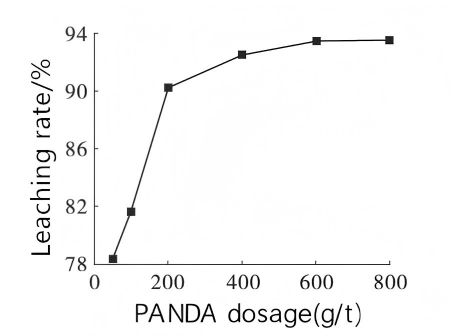
Figure 1: The leaching rate plateaus after 200 g/t, proving higher dosages are not cost-effective.
3. Lime and pH Control
Finding: Lime is crucial for maintaining the alkaline environment required for FKN to work.
Optimization: The optimal lime dosage was found to be 3,500 g/t. Beyond this point, the increase in gold dissolution was negligible.
4. Leaching Time: Avoiding Over-Mixing
Finding: The leaching rate increased steadily over time but began to drop slightly after 18 hours.
Reason: Prolonged agitation caused the clay minerals to re-adsorb some of the dissolved gold ions.
Solution: The ideal leaching time was set at 18 hours.
The Final Result: Full-Process Validation
After locking in the optimal parameters, a full-process test was conducted. The results were impressive:
| Parameter | Value | Significance |
|---|---|---|
| Raw Ore Grade | 0.92 g/t | Low-grade, but viable |
| Tailings Grade | 0.09 g/t | Very low, indicating efficient extraction |
| Leaching Rate | 90.24% | Commercially excellent recovery |
| PANDA Dosage | 200 g/t | Low cost compared to industry average |
Why This Matters for Your Operation
If you are sitting on a low-grade, oxidized gold deposit in a region with strict environmental regulations (like Guizhou or Yunnan), this case study offers a clear roadmap:
Switch to Agitation: If your ore is too clayey for heap leaching, use agitation to avoid channeling.
Control the Mud: Keep the grinding fineness around 75% -0.074mm to prevent viscosity issues.
Optimize PANDA Usage: Start with 200 g/t as your baseline dosage. This data proves you don't need to overdose to achieve high recovery.
Conclusion
The successful treatment of this refractory clay ore demonstrates the versatility of the PANDA environmentally friendly gold leaching agent. It is not just a "drop-in" replacement for cyanide; it is a solution capable of handling complex physical ore structures that traditional methods struggle with. With a low residual grade of 0.09 g/t and a low reagent cost, PANDA proves that environmental responsibility and economic efficiency can go hand in hand.
Related Catalogues:
Related Products:
Related Solutions:
SELECTIVE METAL RECOVERY SYSTEM
FAQ for Low-Cost PANDA Leaching: 90.24% Recovery from Refractory Silicified Clay Gold Ore
1. What is the optimal PANDA reagent dosage for silicified clay gold ore?
Answer: The optimal dosage is 200 grams per ton (g/t) of ore. The test data shows that at this dosage, the leaching rate reaches 90.24%. Increasing the dosage beyond 200 g/t (e.g., to 400 g/t) only improves recovery by an additional 2.17%, which is not considered economically viable under current market conditions.
2. Why is the leaching time limited to 18 hours for this type of ore?
Answer: The leaching time is set to 18 hours to prevent "over-mixing." The ore contains clay minerals that, when agitated for too long, can become re-adsorbed by the dissolved gold ions. Extending the leaching time beyond 18 hours actually caused a slight decrease in the overall leaching rate due to this re-adsorption effect.
3. What is the effect of grinding fineness on the leaching of clayey gold ore?
Answer: Grinding fineness has a critical impact. The optimal fineness was determined to be -0.074 mm (74.91%). While finer grinding generally helps liberation, excessive fineness causes the clay to turn into sludge ("mudification"), which hinders the leaching process and solid-liquid separation. This specific fineness balances mineral exposure with manageable viscosity.
4. What is the role of lime in the PANDA leaching process for this ore?
Answer: Lime is used to adjust the pH of the slurry. The optimal dosage is 3,500 g/t. This amount of lime creates the necessary alkaline environment for the PANDA agent to function effectively. The test showed that increasing the lime dosage beyond 3,500 g/t did not significantly improve the gold leaching rate.
5. Can PANDA effectively leach gold from high-silica (>80%) ores?
Answer: Yes. The test ore had a SiO₂ content of 82.92%. The PANDA agent proved highly effective on this strongly silicified material. The high silica content actually helped by creating loose voids in the ore structure, which benefited the infiltration of the leaching agent during the agitation process.