


Overcoming Serpentine Mud: 94.68% Gold Recovery via Flotation-PANDA Leaching Process
Executive Summary
Dealing with serpentine-rich, high-sludge gold ores is one of the most persistent headaches in mineral processing. The mud-forming nature of serpentine and chlorite gangue minerals often leads to poor flotation selectivity, high reagent consumption, and significant metal loss in tailings.
This case study details a successful Flotation-Leaching Combined Process implemented on a complex gold-copper ore from Jilin, China. By optimizing the flotation circuit using sodium hexametaphosphate as a depressant and utilizing the PANDA environmentally friendly gold leaching agent for tailings reprocessing, the operation achieved a remarkable comprehensive gold recovery rate of 94.68%.
The Challenge: "Muddy" Gangue Minerals
The ore in question presented a classic metallurgical puzzle. While it contained valuable gold (6.59 g/t) and copper, the gangue was dominated by dolomite, diopside, serpentine, and chlorite. These minerals are notorious for:
Slime Generation: Creating fine particles that coat valuable minerals.
Heterocoagulation: Causing non-selective aggregation, sending gangue to the concentrate.
Mechanical Entrainment: Dragging fine gold particles into the tailings via froth entrainment.
Initial assessments showed that traditional flotation alone was insufficient, leaving 1.8~2.0 g/t of gold in the tailings.
The Two-Stage Strategy: Flotation Concentration + PANDA Tailings Leaching
Stage 1: Optimized Flotation for Primary Concentration
To combat the "slime" effect, the test focused on reagent optimization.
Depressant: Sodium hexametaphosphate (2500 g/t) was chosen over traditional water glass or CMC. It effectively changed the surface potential of serpentine, dispersing it and preventing it from floating with pyrite.
Collectors: A combination of 1801 (40 g/t) + Amyl Xanthate (70 g/t) provided the best balance of grade and recovery.
Result: A high-grade gold concentrate was produced with:
Gold Grade: 158.6 g/t
Gold Recovery: 73.40%
Copper Recovery: 73.75%
Silver Recovery: 74.22%
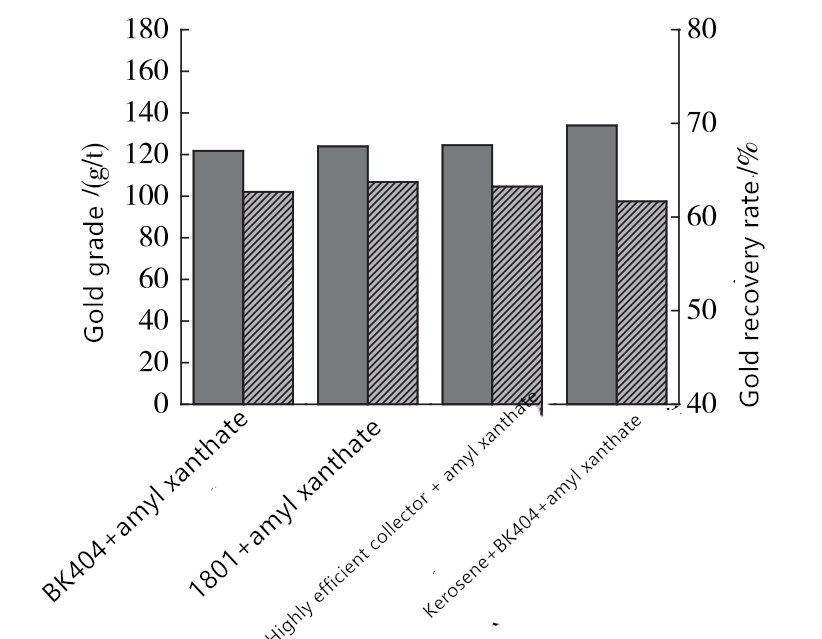 Figure 1: Collector comparison showing 1801 + Amyl Xanthate outperforming other combinations in recovery.
Stage 2: PANDA Leaching for Tailings Reclamation
The real breakthrough came from treating the flotation tailings (still containing 1.8 g/t Au) with the PANDA agent. This step is crucial for ores where "locked" gold cannot be liberated by grinding alone.
The PANDA Advantage:
Unlike cyanide, which struggles with environmental regulations and complex ores, PANDA proved highly effective in the alkaline environment required for this ore type.
Optimal Leaching Conditions:
pH Adjuster: Lime (2000 g/t) to maintain pH 12~13.
PANDA Dosage: 3000 g/t.
Slurry Density: 50%.
Leaching Time: 24 hours.
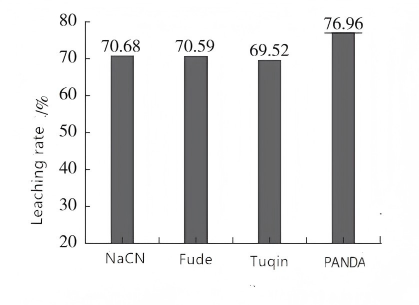
Figure 2: PANDA outperforms other eco-agents (Fude, Tuqin) and matches/exceeds cyanide in leaching efficiency.
The Results: Data-Driven Success
The decision to use a combined process was validated by the numbers. The table below summarizes the performance of the PANDA agent on the tailings.
| Parameter | Value | Significance |
|---|---|---|
| Slurry Density | 50% | High density reduces water usage and tank volume. |
| Leaching Time | 24 hours | Kinetics are favorable for standard CIL/CIP tanks. |
| Gold Leaching Rate | 80.00% | Transforms waste into profit. |
| Final Comprehensive Recovery | 94.68% | Solves the "low recovery" problem. |
Why This Matters for Your Operation
If your mine is processing refractory ores with high magnesium content (serpentine) or dealing with high sludge generation, this case study offers a blueprint:
Suppress the Slime: Use sodium hexametaphosphate to deflocculate and depress serpentine.
Don't Waste the Tailings: Use PANDA to leach residual gold from flotation tails.
Go Green: Eliminate cyanide while increasing your bottom line.
Conclusion
The Flotation-PANDA Leaching Process is a powerful solution for "dirty" or complex gold ores. It demonstrates that even ores with high serpentine content and fine-grained dissemination can achieve world-class recovery rates (>94%) through process innovation. By adopting this strategy, mining operations can turn a problematic, muddy ore into a highly profitable asset.
Related Catalogues:
Related Products:
Sodium/Potassium Amyl Xanthate(SAX,PAX)
Related Solutions:
GOLD RECOVERY OPTIMIZATION SYSTEM
FLOTATION PROCESS OPTIMIZATION SYSTEM
FAQ for Overcoming Serpentine Mud: 94.68% Gold Recovery via Flotation-PANDA Leaching Process
1. How do you suppress serpentine gangue in gold flotation circuits?
Based on the Jilin gold mine case study, sodium hexametaphosphate is highly effective as a serpentine depressant. The optimal dosage was found to be 2,500 g/t. Unlike traditional inhibitors like water glass, sodium hexametaphosphate changes the surface potential of serpentine particles, preventing them from adhering to valuable sulfide minerals (like pyrite) and being mechanically entrained into the concentrate.
2. What is the recovery rate of the PANDA leaching agent on flotation tailings?
In this specific application, the PANDA agent achieved a gold leaching rate of 80.00% on the flotation tailings. The tailings still contained 1.8 g/t of gold after flotation, and the PANDA process successfully recovered this residual gold, contributing significantly to the final comprehensive recovery rate of 94.68%.
3. What are the optimal conditions for using PANDA on high-sludge ores?
The experiment determined the following optimal parameters for this type of ore:
pH: 12~13 (adjusted using 2,000 g/t of Lime).
PANDA Dosage: 3,000 g/t.
Slurry Density: 50% (This high density is economically advantageous).
Leaching Time: 24 hours (The kinetics showed the rate stabilized after this time).
4. Can PANDA replace cyanide for refractory gold ores with high magnesium content?
Yes. The test compared PANDA against potassium cyanide and other eco-agents (Fude, Tuqin). The results showed that PANDA had the highest gold leaching efficiency on these specific flotation tailings. This makes it a viable, and often superior, alternative to cyanide, especially for ores where cyanide consumption might be high due to gangue reactions.
5. What is the comprehensive gold recovery rate using the Flotation-PANDA combined process?
The research achieved a comprehensive gold recovery rate of 94.68%